Sharing Love and Gratitude
Dick Wildeman
September 2026
There had been no rain for two months when I arrived in Haiti last week. All their gardens had dried up under the intense tropical sun. This should have been time for their second harvest of the year, but the crops had already been lost when the rain finally came on my last day there. The majority of Haitians, who were already chronically malnourished, now face even more severe hunger in the weeks and months ahead.
Meanwhile, little else has changed. Gangs still control 90% of the capital of Port-au-Prince, but fortunately not the north of the country or the southern peninsula. After ten years without a functioning government, there is talk of registering people to vote, but it’s unclear how elections could take place without disarming the gangs. The only news we hear in the States focuses on the exceptional acts of violence, like the recent gang massacre of many innocent people in the mountain village of Kenscoff near the capital. We don’t hear about the thousands more who die violently each year at the hands of those they call “bandits."
When I first visited Haiti many years ago, I fell in love with simple people who had nothing and were happy. They knew everything was a gift from God, and they were incredibly grateful. I felt enlivened by their smiles, their generosity and their deep faith in God. It was much the same on this trip. When I asked people, “how are you?” they still gave the usual responses of “not too bad,” “we’re well,” or maybe “we’re holding on.” During my January visit many spoke of Haiti’s “insecurity.” I didn’t hear that word quite as much this time, but maybe that’s because feeling insecure has become a more normal part of their lives.
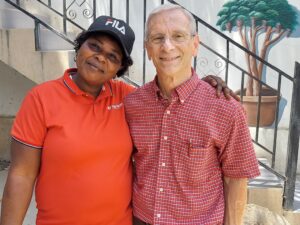
Haitians tend to smile a lot, so it’s surprising that it’s so challenging to get them to smile when I take their picture. They seem to prefer to look solemn in photos, but even so, I was struck by a photo I took of Viola, a middle-aged woman who has long cared alone for a number of children, her own along with others whose parents had died. Viola is a simple woman with little education. She has always been poor, but also very generous, giving me bananas or coconuts or other fruits from her garden. This time when I took her picture I was struck by the sadness in her eyes.
Few of us could comprehend the struggle Viola faces each day to care for her children, often not knowing how to find food or clothes for them, or replace the sheets of tin on the roof that blew off in a storm. When her children get sick there’s little she can do for them. Her photo shows someone who has suffered much, who knows well the pain of loss, who seems simply worn out by life, and yet still tries to smile.
I felt humbled and inadequate to be the face Viola saw, to be a source of hope for her. The challenges she faces seem overwhelming, and there seemed to be so little I could do to help her deal with them. But when I saw her smile through the pain, I was glad to know that I was there, at least for a short time, to help her carry her burden. I feel abundantly blessed to know her and the many others who come to see me when I visit. I give thanks that I can keep going back to be amazed once again by their smiles, their faith and their heartfelt gratitude, and in some small way to share our love with them and show them we still care.
Thank you for visiting
St. Joseph The Worker is committed to the people of Haiti. You can assist with the personal and educational development of individuals and groups in Haiti. The Foundation also provides care and relief for Haiti's medically ill and impoverished. Please consider a donation using the PayPal link below.